Home Blog Page 11

Quarles Highlights Federal Reserve Priorities in Relation to the Insurance Sector During NAIC International Insurance Forum Keynote

0

Washington, D.C.– Vice Chair of Supervision, Federal Reserve Board and Chair of the Financial Stability Board, Randal K. Quarles, addressed the National Association of Insurance Commissioners (NAIC) via pre-recorded remarks during this year’s virtual NAIC International Insurance Forum. Quarles’ remarks were shared on Wednesday, March 26, and reinforced the importance of Federal Reserve and state insurance regulator collaboration in key domestic and international initiatives.

Quarles highlighted a few of the Federal Reserve’s priorities and shared that insurance and insurers relate closely to the Federal Reserve’s mission to provide the nation with a safe, flexible, and stable financial system.

Quarles stated one priority is monitoring the impact of the COVID event and noted that the insurance industry performed very well throughout the pandemic, crediting the industry and supervisors for this strong showing.

Quarles touched on the Board’s most significant project related to insurance and its role in supervision with the development of a capital rule for insurance depository institution holding companies subject to its supervision, as required by the Dodd-Frank Act. He provided a recap and explanation for the Building Block Approach (BBA), which uses the existing and time-tested frameworks that have been tailored specifically to measure appropriately particular risks.

Relatedly, Quarles congratulated the NAIC on adopting its Group Capital Calculation (GCC) at the end of last year and noted how the work on the BBA and GCC has helped with the development of the Aggregation Method at the international level, which could be considered an equivalent implementation of the International Association of Insurance Supervisors’ (IAIS) Insurance Capital Standard (ICS). Quarles stated that as currently constructed, the ICS would not be appropriate as a capital rule for U.S. internationally active insurance groups and described the process underway within the IAIS to assess whether the Aggregation Method and ICS have a sufficient level of comparability.

Climate change as an emerging risk is another priority that Quarles said the Board is monitoring. He noted that the insurance industry has been at the forefront of work to better understand climate-related financial risks, including through climate change modeling.

New Xactimate Feature Helps Property Professionals Estimate and Manage Water Mitigation, Interior and Exterior Claims in Minutes

0

LEHI, Utah — Property professionals can now save significant time estimating and managing water mitigation, interior, and exterior claims with SmartScope™, a new feature in Verisk’s Xactimate and XactAnalysis solutions. Verisk (Nasdaq:VRSK) is a leading global provider of predictive analytics and decision-support solutions.

The new SmartScope™ feature in Xactimate, powered by Vai™, rapidly guides property professionals through the estimating and repair process for water mitigation, interior, and exterior claims. Estimators simply answer dynamic questionnaires, apply line items, select property characteristics and then SmartScope automatically calculates repair costs. Water mitigation technicians can create floor plan diagrams, manage equipment placement and enter moisture readings from Xactimate mobile.

Xactimate® and XactAnalysis® are powerful claims-estimating and claims management solutions developed by Verisk’s Xactware business. SmartScope is part of the next generation of InsurTech powered by Verisk artificial intelligence and automation, or Vai.

“Verisk and Xactware remain committed to helping property professionals shorten workflows with higher-quality and more efficient outcomes,” said Xactware President Mike Fulton. “We couldn’t be more pleased to introduce this new set of tools to greatly enhance efficiency, speed, quality, and consistency throughout the estimating and claims management process. Further, the SmartScope toolset is included at no additional cost with each Xactimate Pro license, requiring no additional software to download or install, nor additional transaction fees for the use of SmartScope.”

SmartScope enables property professionals to work directly from within Xactimate’s Sketch tool — using digital diagrams either imported from third-party services or manually created — to answer questions in dynamic forms that are auto-generated for each applicable job type. SmartScope then applies the appropriate quantity of line items and fully audits and scores the estimate based on building techniques and general scoping practices, such as the IICRC’s S500 standards for water mitigation or a company’s specific scoping rules. Estimators can even create, measure and score custom drying plans for water mitigation losses.

Xactware customers excited by SmartScope benefits

“SmartScope is the first tool on the market to be able to help our franchises capture and guide them through a better scope and audit as they are doing the job,” ServPro Chief Information Officer Jeff Fields said. “It also benefits our insurance clients and our customers by providing a more accurate scope and allows us to adjust the scope while the job is in progress.”

American Technologies, Inc. President Jeff Moore also sees benefits for estimators, clients and insurance companies: “SmartScope provides ATI with assurance in knowing we will continually exceed customer expectations while better managing the business through the creation of consistent, accurate and quality estimates for various job scenarios. SmartScope will also benefit the industry as a whole, by reducing the complexity and errors of an ever-increasingly rule-driven industry.”

SmartScope will be available with the latest version of Xactimate Pro starting June 29 to profiles with the feature flag enabled. SmartScope is available with the latest version of Xactimate Pro. To learn more about this new feature, watch the “A New Approach to Water Mitigation” session at VeriskElevate.com.

Liberty Mutual and Safeco Release Rise of the Digital Insurance Agency Report

Customer expectations around digital are changing rapidly. To explore how independent insurance agencies (IAs) are evolving to meet new expectations, today, Liberty Mutual and Safeco Insurance released the Rise of the Digital Insurance Agency report. Based on a survey of nearly 600 US-based independent agents and brokers, the research examined the connection between revenue and digital adoption and found that digitally savvy agencies grow faster – 60% more on average – than their less digital counterparts. The report also introduces the Agent for the Future™ Index, which measures the state of digital transformation in the IA channel, and uncovered seven revenue-driving digital capabilities.

Explore the research findings at www.AgentForTheFuture.com/DigitalAgencyReport.

“Digital is a trend that has been building for decades now, and COVID-19 has simply accelerated the need for transformation,” said Tyler Asher, president of Independent Agent Distribution at Liberty Mutual and Safeco Insurance. “While we know anecdotally that deeply digital independent agencies generate more leads, operate more efficiently and have happier customers, this research offers a clear picture of the business value digital can provide, which is that high digital adoption leads to faster growth.”

This research comes at a crucial time for the independent agent channel, which continues to grapple with the implications of disruption spurred by the global pandemic and growing expectations around doing business digitally. By examining the business value of digital and distilling key trends into actionable insights, the Rise of the Digital Insurance Agency report helps agents and brokers strategically navigate the rapidly changing marketplace. Core to the research is an evaluation of specific tactics through the inaugural Agent for the Future Index, which scores agencies on a 10-point scale based on adoption across a range of digital capabilities weighted by complexity.

The Index broke respondents out into three groups – low, medium and high digital adoption – to account for variance in adoption and gauge which capabilities offer the greatest lift to revenue growth. Overall, agencies within the low adoption group scored an average of 2.76 while high adopters scored an average of 6.76 on the 10-point scale, highlighting a significant opportunity for all agencies to become more deeply digital. Year-over-year, agencies within the low digital adoption group grew an average of 7.4%, while high adopters grew an average of 12% – equating to a more than 60% greater lift in revenue growth for highly digital agencies.

More than 20 digital capabilities were analyzed as part of the Index, seven of which were strongly correlated with high revenue growth, giving agencies a better understanding of which capabilities to prioritize on their digital transformation journey. The seven opportunities span a range of capabilities across a spectrum of complexity including fundamentals (social media, online quotes), modernizations (self-service portal, live online chat) and innovations (paid social media advertising, video quotes and policy reviews, and AI and chatbots).

Additional key trends and takeaways of the Rise of the Digital Insurance Agency report include:

Marketing will hit its tipping point in the transition to digital in 2021

Now more than ever, independent agents are finding value in digital marketing as a growth lever, with a vast majority of all agencies indicating digital marketing is key priority this year. More than 80% of high digital adopters plan to increase digital marketing efforts in the next year. While about one-quarter (27%) of low digital adopters currently do not do any digital marketing and do not plan to in the future, nearly half (48%) plan to increase efforts in the next year indicating that 2021 is the year marketing in the IA channel will be more digital than not.

Video remains a largely untapped opportunity

One of the deepest digital divides between high and low adoption agencies is in the use of video. Forty-four percent of high adopters plan to either start or continue leveraging video for quotes and policy reviews post-pandemic, with just 9% of low adopters indicating the same. As a key revenue-driving tactic, there is a significant opportunity for agencies at all stages of their digital transformation journey to adopt video for quotes and policy reviews.

Digital agencies can invest more in the customer and employee experience

Independent agencies that already invested in digital can prioritize growth in other areas of the business, such as hiring and customer education. Comparatively, low adopters will be implementing digital fundamentals such as building an online presence and introducing online business tools like e-signature to find success in 2021. Across the board, high digital adopters also hired more.

“Beyond the digital takeaways, the research findings also tell us that the independent agent channel is stronger and more agile than ever,” Asher said. “Independent agents were built to evolve and many are approaching this latest challenge with the same sense of adaptability that has allowed the channel to thrive for more than a century. We at Liberty Mutual and Safeco are here to help IAs push the boundaries of what is possible by offering the resources and actionable advice they need to win with digital.”

The full findings are available on AgentForTheFuture.com, a free resource Liberty Mutual and Safeco offer to help lift up the entire independent agent channel. Through expert insights, agent stories and proprietary research, Agent for the Future offers actionable advice for the most forward-looking IAs. Explore the digital report experience or download the PDF version at www.AgentForTheFuture.com/DigitalAgencyReport.

Methodology

The Rise of the Digital Insurance Agency report surveyed 596 US-based independent agency principals, producers and CSRs about the impact of COVID-19, the current state of their agency and their digital priorities over the next year. The research was conducted online by in-house Liberty Mutual and Safeco Insurance research experts in October 2020. Survey respondents included independent agencies that sell personal lines, small commercial or a combination of both, with results indicating no significant variance in digital adoption based on the type of policies an agency sells.

About Liberty Mutual Insurance

At Liberty Mutual, we believe progress happens when people feel secure. By providing protection for the unexpected and delivering it with care, we help people embrace today and confidently pursue tomorrow.

In business since 1912, and headquartered in Boston, today we are the sixth largest global property and casualty insurer based on 2019 gross written premium. We also rank 77th on the Fortune 100 list of largest corporations in the U.S. based on 2019 revenue. As of December 31, 2020, we had $43.8 billion in annual consolidated revenue.

We employ over 45,000 people in 29 countries and economies around the world. We offer a wide range of insurance products and services, including personal automobile, homeowners, specialty lines, reinsurance, commercial multiple-peril, workers compensation, commercial automobile, general liability, surety, and commercial property.

For more information, visit www.libertymutualinsurance.com.
The National Alliance CISR High School Program Expands Into Birmingham School System

Austin, Texas – The National Alliance announced the expansion of the CISR High School Program into seven high schools in Birmingham, Alabama. The program was approved for accreditation with the Alabama Department of Education as a new Career and Technical Education Insurance Program of Study which helps students earn an insurance designation and an industry-based certification upon graduation.

Jack Elliot, CRC Group Chief Administrative Officer and CISR Board Chairman, shared this about the expansion:

“Thirty years ago, when I was 15, I walked into an insurance agency in Birmingham because of a high school program. It feels extremely rewarding to bring the same kind of insurance courses that inspired my insurance career back to the state. The CISR High School program gives students excellent opportunities for future success. School systems, teachers, family, and communities win when students are offered career education. The insurance industry also wins, as we work to fill positions over the next few years.”

The high school program is being bolstered by local insurance agencies offering internships and entry-level career opportunities. Twenty-five letters of support were sent to the Department of Education to help facilitate this insurance pathway for Alabama high schools.

Bill Jacka, Jr., Executive Vice President at Alabama Independent Insurance Agents, Inc., and CISR High School program advocate, shared this:

“We’re excited to see years of hard effort pay off on this life-changing opportunity for Birmingham’s high-school youth. The CISR High School program will educate them, give them the chance to work in our field, and help them become adept insurance consumers. It’s vital that insurance agents and the community have an active role in shaping today’s youth. We look forward to working with the school systems, faculty, and students to bring them excellent career options with immense potential.”

The CISR High School program will be offered in August 2021 to all secondary education and high school campuses within Birmingham’s public school system.

For more information about the CISR High School Program and how you can bring it to your school, district, or community, visit www.scic.com/cisr-for-high-school.

The National Alliance for Insurance Education & Research is the nation’s premier provider of educational opportunities for insurance and risk management professionals. Learn about us at www.scic.com.

Applied Underwriters’ Exceptional Care for Injured Workers Featured in Fall TV Series on Discovery Life

OMAHA Officially recognized for its extraordinary care for injured workers as a leading US workers’ compensation insurer, Applied Underwriters will be featured in episodes of an upcoming TV series called Back from the Brink. The series, set for the fourth quarter of 2021 and the first quarter of 2022 on the Discovery Life channel (https://www.discoverylife.com), will be presented weekday evenings in prime time nationally. Each episode will feature the real-life stories of individuals who suffered and survived near death accidents, but whose sudden, dire circumstances required an enormous degree of care from a cross-section of individuals and professionals working with unusual devotion to bring these victims back to enjoy a good quality of life.

Back from the Brink researchers identified several sources, including Applied Underwriters, because it has been regularly cited, including recently by the State of California, as a top performer in claims management. Several of the episodes will be drawn from Applied Underwriters’ files, notably the stirring saga of an electrical lines worker who was electrocuted falling to his “near death” only to be rescued and brought back to life with the use of his limbs and a reconfigured face and neck through groundbreaking surgeries. A second, compelling story is that of a severely injured lumberjack who fell 60 feet to the ground and was crushed by the tree he was cutting, only to be brought back to vitality by an amazing concert of a giving family, devoted clergy, and a talented, focused team of professionals.

The choice of Applied Underwriters’ experiences and successes in treating patients all the way through to the revitalization of their lives and capacities is a great source of pride for Applied, according to Steve Menzies, the Company’s Chairman: “The role that our Claims Department and others have played in the recovery of so many injured workers over the years is itself a deep source of gratification to the Company’s dedicated staff; that it is recognized and selected for airing, is a second source of great satisfaction to us all.”

Mr. Menzies continued, “Our philosophical approach is ‘service well beyond the letter of the policy and the financial resolution.’ We believe that our Company’s good soul is expressed in the treatment of claimants, especially injured workers who have had to come ‘back from the brink.’”

The program will look at the ways an injured person’s community of resources worked to overcome challenging odds, following changing courses and regimens as the patients recovered and reached the plateaus that marked progress, according to Mr. Menzies, who concluded: “We believe that the insurance industry does not get the credit it deserves for playing a role beyond simply paying claims fully and promptly, so we appreciate the angle that this show takes – demonstrating that recovery is a concerted effort of many committed professionals who, while concentrating upon one injured worker, martial resources from far and wide to bring to bear – all, with special determination and courage. We hope the series will present insurers in a more fittingly favorable light and have a great following. We are delighted to be a part of it.”

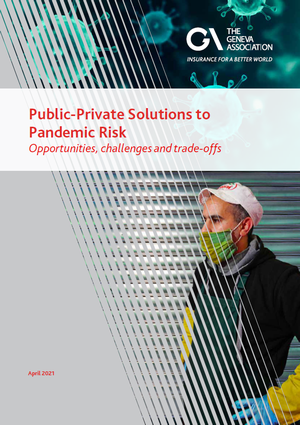
To Protect Businesses From Pandemic Risk, Governments Need To Be ‘Insurers of Last Resort’: New Geneva Association Report

ZURICH, 21 – COVID-19 has illustrated that pandemic-related business interruption is directly linked to the decisions of governments to implement lockdown measures, making it impossible for insurers to model and price such a risk. Furthermore, it is systemic in nature, inducing widespread and simultaneous financial losses. Coverage for pandemic business continuity risks with meaningful limits will therefore remain unavailable from the private insurance market due to prohibitively high capital requirements. Government involvement is essential to enhancing preparedness for and resilience to future pandemic shocks.

In this context The Geneva Association has just released Public-Private Solutions to Pandemic Risk, expounding four exemplary pandemic risk funding schemes where governments can play a leading role:

Direct insurance: the public sector provides voluntary or mandatory insurance to businesses exposed to pandemic risk

Reinsurance: governments provide reinsurance coverage to insurers that kicks in above a certain threshold and up to a certain limit

Social insurance: modest public-sector coverage with mandatory participation through pre-event payments (e.g. tax or levy)

Post-event protection: an ad hoc safety net offered by governments to those affected

Recognizing there is no one-size-fits-all solution, the report assesses the benefits of each scheme against seven public policy goals: 1) maximum coverage, 2) limited public exposure, 3) matching of funds with needs, 4) risk mitigation incentives, 5) cost-efficiency of risk transfer, 6) operational efficiency, and 7) macroeconomic benefits.

Jad Ariss, The Geneva Association’s Managing Director, said: “It is a tragedy that businesses, particularly SMEs, have suffered so much financial loss during the pandemic as a result of the lockdowns, which were beyond their control. The public sector had to step in with multi-trillion dollar emergency relief measures. Governments and insurers must work together on how to close the massive protection gap exposed by COVID-19, with governments as the leading players.”

Kai-Uwe Schanz, The Geneva Association’s Head of Research & Foresight and the leading author of the report, said: “We want to emphasise that of the four pandemic risk insurance schemes outlined, distributing cash post-event – as many governments did for COVID-19 – is likely least effective. For the other schemes, deciding whether participation is mandatory or voluntary, as well as the role of insurers in pricing and offering coverage, are critical considerations. We hope this report effectively guides governments and insurers in finalising their partnership terms.”

About The Geneva Association

The Geneva Association is the only global association of insurance companies; its members are insurance and reinsurance CEOs. Based on rigorous research conducted in collaboration with its members, academic institutions and multilateral organizations, The Geneva Association Identifies and investigates key trends and risk areas that are likely to shape or impact the insurance industry and develops corresponding recommendations for the industry and for policymakers.

In total, the companies of Geneva Association members are headquartered in 25 countries around the world; manage USD 17.1 trillion in assets; employ 2.4 million people; and protect 1.8 billion people.

Ryan Specialty Group Announces New Leadership for RSG’s Transportation Practice and Interstate Insurance Management

Ryan Specialty Group, LLC (RSG) is pleased to announce the following leadership changes for the company’s transportation offerings.

RT Specialty, Ryan Specialty Group’s wholesale brokerage, is appointing Doug Hathaway Head of its National Transportation Practice as well as its commercial transport program: Interstate Insurance Management (Interstate).

Dennis Beecher will be promoted to President of RT Specialty Johnstown, PA.

Jack Buchan, President and CEO of Interstate, will be retiring June 30, 2021 after a long and successful career in commercial transportation insurance underwriting and management.

Commenting on the new leadership appointments, Ryan Specialty Group Founder, Chairman and CEO, Patrick G. Ryan, said, “Doug and Dennis are both experienced transportation experts with deep knowledge in this complex class of business and have done excellent work creating insurance solutions for Interstate’s clients and trading partners. I am excited to watch RSG’s transportation offerings continue to thrive and grow under their leadership. I would like to congratulate Jack Buchan on an outstanding insurance career and thank him for building the Interstate we know today. We wish him the best in all his future endeavors.”

Learn more about RSG at https://ryansg.com/.

Triple-I: 2021 Atlantic Hurricane Season Forecast To Be ‘Above-Average’

ST. JOHNS, Fla., – An above-average level of tropical cyclone activity is projected for 2021, a year after a record-setting 30 named storms developed during 2020’s Atlantic hurricane season, according to a forecast released by Colorado State University’s (CSU) Department of Atmospheric Science.

Led by research scientist Phil Klotzbach, PhD, also a non-resident scholar at the Insurance Information Institute (Triple-I), the CSU Tropical Meteorology Project team anticipates 17 named storms, eight hurricanes and four major hurricanes during the 2021 season, which starts on June 1 and continues through Nov. 30. A typical year has 12 named storms, six hurricanes and three major hurricanes.

Thirteen of the 30 named storms that occurred in 2020 were hurricanes. Six of the 13 hurricanes in 2020 became major hurricanes. Major hurricanes are defined as those with wind speeds reaching Category 3, 4 or 5 on the Saffir-Simpson Wind Scale. A record-setting 11 named storms made landfall in 2020 in the continental U.S.

“Last year, millions of American lives were disrupted by the record-setting number of storms, many of which generated catastrophic wind and water damage. All it takes is one storm to make it an active season for you and your family, so now is the time to prepare as the start of 2021’s Atlantic hurricane season nears,” said Sean Kevelighan, CEO, Triple-I.

“Homeowners and business owners should review their policies with an insurance professional to ensure they have the right amount and types of coverage, allowing them to be financially protected from property damage caused by either wind or water,” Kevelighan added. “That also means exploring whether they need flood coverage, which is not part of a standard homeowners, renters or business insurance policy. Additionally, they should take steps to make their homes more resilient to windstorms and torrential rain, such as installing roof tie-downs and a good drainage system.”

Flood policies are offered through FEMA’s National Flood Insurance Program (NFIP) and several private insurers. The installation of a wind-rated garage door and storm shutters also boost a home’s resilience to a hurricane’s damaging winds, according to the Triple-I.

Private-passenger vehicles damaged or destroyed by either wind or flooding are covered under the optional comprehensive portion of an auto insurance policy.

Through its Resilience Accelerator and other educational materials, the Triple-I offers numerous hurricane season preparedness tips. These include:

  • Developing a photo/video inventory of your possessions and your home’s exterior, which will ease the claims-filing process
  • Preparing a hurricane emergency kit with a minimum two-week supply of essential items, such as drinking water, non-perishable food and COVID-19 safety items (face coverings, hand sanitizer)
  • Creating an evacuation plan well before any storm warnings are issued

Klotzbach said the likely absence of a significant El Niño in the Pacific is a primary factor that indicates an active Atlantic hurricane season is on the horizon.

“Tropical Atlantic sea surface temperatures are near their long-term averages, while subtropical Atlantic sea surface temperatures are much warmer than their long-term average values. The warmer subtropical Atlantic also favors an active 2021 Atlantic hurricane season,” Klotzbach stated.

CSU predicts that 2021 hurricane activity will be about 140 percent of the average season, while 2020’s hurricane activity was 170 percent of the average season. The 2021 forecast indicates a 69 percent probability that at least one major hurricane will make landfall in the continental U.S. this year.

EMC Announces Promotions and Officer Appointments

0

DES MOINES, Iowa EMC Insurance Companies has announced several officer elections and elevations:

Lucreia Smith, MBA, CPCU, AINS, has been promoted to vice president – strategy execution where she will oversee the strategic execution of business priority goals and organizational change. Smith joined EMC six years ago and most recently held the title of assistant vice president – change management. She received a bachelor’s degree in business management from Roosevelt University in Chicago and a Master of Business Administration degree from Lewis University in Romeoville, Illinois.

Karey Anderson, CFA, has been named vice president – portfolio manager. She is involved with all facets of the investment process, including implementing philosophy and strategy for the investment portfolio of member companies. Anderson joined EMC 19 years ago as an Associate Securities Analyst and has served in various investment management positions since that time. She holds bachelor’s degrees in both finance and economics from Drake University in Des Moines, Iowa.

Derek Dunnagan, MBA, FCAS, CPCU, has been promoted to vice president – pricing and modeling, co-leading the company’s actuary department. Dunnagan joined EMC in 2017 as an assistant vice president – principal actuary. He received a bachelor’s degree in actuarial science from the University of Illinois in Champaign, Illinois and a Master of Business Administration degree from National Louis University in Chicago.

Sarah Buckley, APR, was elected assistant vice president – community involvement, overseeing charitable giving, media relations, social media and volunteerism at the company. She also serves as the Executive Director of the EMC Insurance Foundation. Buckley joined the company in 2019 as director – community involvement. She holds a bachelor’s degree in journalism and mass communications from Iowa State University in Ames, Iowa.

Lee Henderson, J.D., CIPP/US, has been named assistant vice president – associate general counsel – contracts and privacy. Henderson provides legal expertise in the areas of contract negotiation and management, information privacy and security, innovation and real estate. He joined EMC in 2016 as a staff attorney. Henderson received a bachelor’s degree in history from Knox College in Galesburg, Illinois, and a Juris Doctor degree from Drake University in Des Moines, Iowa.

Natali Justiniano Pahl, MBA, has been promoted to assistant vice president – team member development where she will lead people development strategies for the company. Justiniano Pahl joined EMC in 2020 as director – team member development. She received a bachelor’s degree in business management from the University of Northern Iowa in Cedar Falls, Iowa, and a Master of Business Administration degree from Drake University in Des Moines, Iowa.

About EMC Insurance Companies

EMC Insurance Companies is among the top 60 property/casualty insurance organizations in the country based on net written premium, with more than 2,400 employees. Employers Mutual Casualty Company (EMCC) was organized in 1911 to write workers’ compensation protection in Iowa. Today, operating under the trade name EMC Insurance Companies, the company provides property and casualty insurance products and services throughout the United States and writes reinsurance contracts worldwide. EMCC is licensed in all 50 states and the District of Columbia. For more information, visit emcins.com.

Liberty Mutual Promotes Wesley Hyatt To Chief Client Officer of Global Risk Solutions

BOSTON  – Liberty Mutual Insurance announced the appointment of Wesley Hyatt as Chief Client Officer of its Global Risk Solutions (GRS) division. In this role, Hyatt leads the Client Executive team, charged with deeply understanding the evolving risks faced by clients, and helping them and their brokers fully benefit from Liberty Mutual’s suite of global products, services and capabilities. Hyatt also oversees the US Client Service team, which provides day-to-day service support for large domestic policyholders and their brokers.

“Liberty Mutual aspires to be the world’s most respected commercial and specialty (re)insurer,” said GRS President Dennis Langwell. “To earn that distinction, we’ve built our organization around the needs of our clients and brokers. As Chief Client Officer, Wes plays a critical role in ensuring we continue to do that.”

Wesley Hyatt brings the right skills to the position, according to GRS North America President Tracy Ryan. “Liberty Mutual’s deep expertise, regional presence and continuously-expanding commercial and specialty insurance offering ideally position us to support the evolving needs of  the most complex risks in the US and across the globe. Throughout her career at Liberty Mutual, I’ve seen firsthand that Wes has the proven leadership and management skills, drive and inclusive approach needed to ensure her team delivers value to clients and distribution partners.”

Wesley Hyatt has held a number of leadership roles at Liberty Mutual in claims and account management, most recently as Senior Vice President of Workers Compensation Claims. In this position, Wes led efforts to enhance Liberty Mutual’s workers compensation business for the benefit of clients, their injured workers and employees across the workers compensation organization. Highlights include digital transformation work with cloud-based technology solutions and improving claim outcomes through an advocacy-based approach.

For more information, visit www.libertymutualinsurance.com.