Home Blog Page 30

2018 Independent Channel Growth Tops Expectations

0

Broker Optimism Remains High

ATLANTA — As the first quarter of the new year winds down, optimism is high among agents and brokers in the independent insurance channel. That’s because they just closed the books on their best year since 2014 and foresee record growth in 2019, according to Reagan Consulting’s Organic Growth and Profitability (OGP) survey for the fourth quarter (Q4) of 2018.

The survey shows “a convergence of impressive upward trends in each major line of business,” says Kevin Stipe, president of the firm.

OGP participants generated organic growth of 6.1% in 2018, surpassing their projected organic growth rate of 5% for the year. Growth was driven by continued increases in U.S. GDP and commercial pricing. For 2019, OGP participants are forecasting growth of 7%, which would be the highest growth rate since Reagan began its quarterly OGP survey in 2008

2018 Independent Channel Growth Tops Expectations

Buyer optimism of agent and broker performance and seller concerns of scale and internal perpetuation planning have fueled what Stipe characterizes as a “frenzy” of mergers and acquisitions (M&A). He says many brokers and agents wondered whether M&A activity could exceed its record-setting pace of 2017 but, “incredibly, deal activity increased by another 7%, reaching 597 announced transactions” in 2018. Two drivers were all-time high valuations and a heavy influx of acquisition capital to private equity-backed brokers.

Agency owners believe that size and scale ensure survival as competition intensifies in the industry, Stipe observes. Small agencies whose owners are facing retirement without a succession plan are also contributing to the increase in transaction count. “Without a viable path to continued independence,” these agencies turn to an M&A transaction, Stipe says.

Employee group benefits was the channel’s leading performer of 2018, growing organically at a rate of 7.3%. This growth rate was more than 2 percentage points higher than last year’s and represents the highest annual growth rate since the OGP survey began in 2008.

Commercial lines’ growth rate also increased by more than 2 percentage points from 2017, as the median firm grew its commercial property and casualty business by 6.5% in 2018.

Personal lines business accelerated its growth rate for the third consecutive year to 3.9%, “which … is the fastest growth rate recorded for personal lines in the 11-year history of the OGP survey,” says Stipe.

In terms of profitability, the channel has remained stable over the last four years. In 2018, earnings before interest, taxes, depreciation and amortization (EBITDA) margin dropped slightly to 20.2%, and contingent revenue, as a percentage of revenue, fell one percentage point. Despite the small drop in profitability, operating margin (which excludes contingent and bonus income) rose slightly in 2018, “implying that brokers and agents were successful in controlling their expenses,” says Stipe.

2018 Independent Channel Growth Tops Expectations

Reagan Consulting has conducted its quarterly survey of agency growth and profitability since 2008, using confidential submissions from nearly 200 midsize and large agencies and brokerage firms. Approximately half of the industry’s 100 largest firms participated in this quarter’s survey. The OGP survey is the industry’s preeminent survey of midsize and large privately held brokers.

For further information and commentary, contact Kevin Stipe at Reagan Consulting, 404.869.2532, kevin@ReaganConsulting.com.

Each participating agency receives a customized, confidential report of its performance compared with the overall survey results, along with Reagan’s quarterly commentary of industry trends affecting agents and brokers. For information on participating in the OGP survey, contact Michelle Appelbaum at 404.233.5545 or michelle@ReaganConsulting.com.
HVAC Claims Continue to Offer Property & Casualty Carriers a Monumental Opportunity to Realize Millions in Claims Leakage Annually

0

HVACi’s 2019 Annual Claims Report showcases the significance of partnering with a third party subject matter expert in identifying and recapturing claims leakage

CHARLOTTE, N.C. — HVAC Investigators (HVACi), the nation’s leading provider of HVAC Refrigeration damage assessments for Property & Casualty insurance carriers, announced the release of its 2019 Annual Claims Report today. The report highlights and analyzes significant data and offers carriers compelling insight into opportunities for claim leakage control.

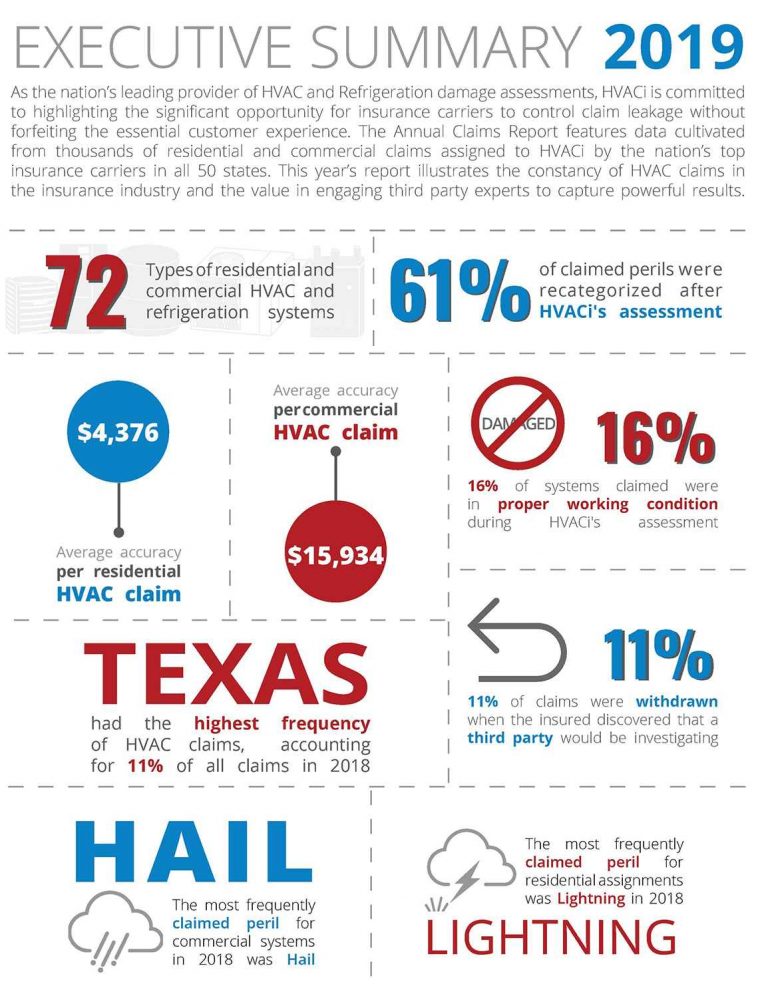
In 2018, 61% of the claimed perils investigated by HVACi were recategorized, with 16% of claimed systems found not damaged during an onsite assessment. This data illustrates that when carriers partner with a trusted, third party expert to evaluate HVAC losses, they can better control and reduce indemnity leakage. Further, the report delves into each policy line, a variety of causes of loss, and the year’s major catastrophes to reveal meaningful data points for Property & Casualty claim professionals. The analysis underscores the prevalence of HVAC claims in the insurance industry and features insights that will be valuable in setting indemnity reserves and making staffing decisions.

Distributed to Property & Casualty insurance carriers nationwide, the HVACi 2019 Annual Claims Report features data derived from many thousands of residential and commercial claims referred to HVACi by the nation’s top carriers in all 50 states. These claims encompass all major perils, manufacturers, and equipment types that adjusters encounter on a day-to-day basis.

This year’s report features popular topics carriers rely on, including Average Claim Accuracy, Repair vs. Replace Frequency, Reported vs. Actual Cause of Loss, and Frequency of Claims by System Type. In particular, claim trends such as Distribution of Claims by State and Reported Claims by Month by Peril offer key insights into setting indemnity reserves. 2019’s report also dives into data from the year’s most devastating catastrophes: Hurricane Florence, Hurricane Michael, and the California wildfires. The increasing trend toward large-scale catastrophes emphasizes the significance of implementing a standardized HVAC investigation process to minimize catastrophe claim leakage. Lastly, new additions to this year’s report include analysis on Repair vs. Replace by System Type, Cause of Damage Frequency by System Type, Equipment SEER Rating trends, and large loss claims examined by building type.

According to Matt Livingston, co-founder of HVACi, “The 2019 Annual Claims Report once again illustrates how significant HVAC claims are in the Property & Casualty insurance industry. This year, the average accuracy for a residential claim was $4,376 and $15,934 for a commercial claim. When you apply these figures to the many thousands of HVAC claims we see on an annual basis, there is over a billion dollars of potential accuracy.” This report will be immediately accessible to insurance professionals. To request a copy, please click here or e-mail education@hvaci.com.

HVAC Investigators (HVACi) is the nation’s leading provider of HVAC and refrigeration damage assessments. Our prompt inspections, actionable reports, and national footprint help insurance carriers settle HVAC claims more quickly and with a higher degree of accuracy. To learn more about our services or to submit an assignment, please visit hvaci.com, email info@hvaci.com, or contact us by phone at (888) 407-5224.

HVAC Investigators is a portfolio company of Consolidated Claims Group LLC (CCG), a leading provider of independent claims investigation services. CCG utilizes technology and custom-built software to produce accurate, actionable, and impartial reports, allowing adjusters to settle property claims with confidence.

Employers Mutual Casualty Company Clarifies its Non-Binding Proposal to Acquire all Shares of EMC Insurance Group Inc.

0

DES MOINES, Iowa — Employers Mutual Casualty Company (EMCC), in response to inquiries and industry reports, seeks to clarify its non-binding indicative proposal dated Nov. 15, 2018, (the “Proposal”) to EMC Insurance Group Inc. (EMCI) to purchase all of the outstanding shares of EMCI common stock not already owned by EMCC for $30 per share in cash. EMCC currently owns approximately 55% of the outstanding shares of EMCI’s common stock.

In the Proposal to EMCI, EMCC indicated that it was willing to engage in an open discussion with EMCI’s special committee on any alternative transaction structures or alternative transactions so desired by the special committee. In response to inquiries and industry reports, EMCC now believes it is important to clarify that this statement was intended only to convey EMCC’s willingness to consider an alternative transaction for it to acquire all of the outstanding shares of EMCI common stock not already owned by EMCC. This statement was not intended to convey that EMCC was willing to consider an alternative transaction brought by EMCI’s special committee or any other party that involves the merger of EMCC with or into a third party. EMCC is not willing to consider any such proposal. EMCC has been operating as an independent mutual insurance company for 108 years. EMCC is a financially strong insurance company with an A.M. Best financial strength rating of A (Excellent), and is currently one of the top 50 insurance organizations in the country based on net written premiums. EMCC intends to continue operating as an independent mutual insurance company, which it believes is in the best interests of its policyholders.

EMCC continues to believe that the proposed transaction is in the best interest of EMCI’s public shareholders. Given the relative limited market trading volume and illiquidity of EMCI’s stock, EMCC believes the transaction will provide EMCI’s public shareholders with immediate and complete liquidity at a significant premium to EMCI’s per share price prior to the public announcement of the Proposal. This price represents an approximately 25% premium to the $23.99 closing market price of EMCI’s common stock on the Nasdaq Global Select Market as of November 15, 2018, the last trading day prior to the public announcement of EMCC’s Proposal and an almost 13% premium to the $26.63 book value per share of EMCI as of September 30, 2018.

Additional Information and Where to Find It
An agreement in respect of the proposed transaction described in this press release has not yet been executed, and this press release is not an offer to purchase or a solicitation of an offer to sell any securities. Any solicitation or offer will only be made through materials filed with the SEC. EMCI shareholders and other interested parties are urged to read these materials if and when they become available because they will contain important information. EMCI shareholders will be able to obtain such documents (when available) free of charge on the SEC’s website, www.sec.gov.

Christopher Lee Named Divisional Vice President of IT

0

LAKELAND, Fla. – Summit, a leading provider of workers’ compensation insurance services in the southeastern United States, announced today that Christopher (Chris) Lee has been named the company’s divisional vice president of IT starting January 1, 2019.

“I am extremely pleased to announce that Chris Lee will assume the role of divisional vice president of IT,” says Carol Sipe, Summit divisional president. “Chris has been an integral part of our technology team for more than 20 years, currently serving as divisional assistant vice president of development. Chris has demonstrated expertise and leadership, which make me extremely confident in his capabilities.” Mr. Lee will follow in the footsteps of Kelly Stone, who is retiring from the position at the end of this year. Ms. Stone has been a key part of Summit’s significant advancements in technology for more than 30 years.

Mr. Lee currently resides in Lakeland, Florida. He graduated from Tennessee Technological University in Cookeville with a Bachelor of Science in Management Information Systems (MIS). He also earned a Master of Business Administration from Regis University in Denver, Colorado.

Cybersecurity Requirements

0

You may have recently received an email or other notification from the New York Department of Financial Services (NY DFS) regarding its new cybersecurity requirements that became effective just over a year ago (on March 1, 2017). If so, some guidance as to how to respond might be helpful.

By way of background, the NY DFS cybersecurity regulations require financial institutions and insurance-related companies (including brokers and agents) licensed in New York to adopt written cybersecurity programs that meet certain specific criteria described in the regulations. All licensees were required to electronically file a Certificate of Compliance prior to February 15, 2018, confirming that the required policies and programs have been prepared and implemented, including but not limited to a comprehensive written cybersecurity policy, data access restrictions, and security requirements for your suppliers, vendors, or third party service providers.

Depending on the size of your organization’s New York operations, you may also be required to draft an incident response plan and designate a Chief Information Security Officer (CISO) to monitor your organization’s information security and report to key stakeholders. Additional DFS cybersecurity requirements triggered on March 1 (including a requirement to perform a risk assessment), with more regulations coming into effect in September 2018. While smaller organizations could qualify for certain limited exemptions, those licensees must electronically file a Notice of Exemption through the NY DFS portal. While the filing deadlines have passed, it is important to adopt these policies and certify compliance as soon as possible to avoid potential regulatory sanctions.

These new regulations put a substantial burden on insurance brokers and agents, who may not have the internal resources or expertise to perform a cybersecurity assessment or prepare the requisite policies. If you are licensed in New York and have not yet filed the requisite Notice of Exemption and/or Certificate of Compliance, or should you need help drafting the required policies or other technical compliance advice, the cybersecurity lawyers at Michelman & Robinson, LLP are available to assist. Please contact Scott Lyon at slyon@mrllp.com or (949) 783-4622.

Scott Lyon
Michelman & Robinson, LLP
slyon@mrllp.com
(949) 783-4622

Test the Depth of your Insurance Knowledge with the Academy of Insurance’s Skills Tests

0

Part of the struggle that we all have with planning our continued learning is answering one question: what do I need to learn? Sometimes the answer seems obvious. You just moved from personal lines to commercial and you need to learn about commercial exposures, policies, etc. Maybe you have a client on the phone asking a question that you can’t answer, so you need to learn something quickly to be able to answer the question.

We created our skills test for those times when we don’t know what we need to learn next. We have four tests that are designed to let you know your level of expertise. We made the tests to be challenging on purpose. We asked detailed questions that require a thorough understanding of coverages and concepts in order to do well. We think insurance professionals are up to the challenge.

If you’re interested in a broad view of all of the tests, you can find them at the Academy of Insurance skills test page. Let’s take a few moments and introduce you to the tests.

  • The Workers’ Compensation Skills Test requires that you understand what triggers coverage, how it applies to employees and independent contractors, how you handle an out-of-state exposure, and more.
  • The Personal Lines Skills Test covers the ISO Homeowners coverage forms and Personal Auto Policy form. You might want to bone up on your definitions, valuations, eligibility, covered autos, and anything else you can think of related to these coverage forms.
  • The Commercial Property Skills Test is a comprehensive review of the commercial property policy. You will also want to look at your business income and extra expense forms and endorsements such as the ordinance or law coverage endorsement, utility service endorsement, and leasehold interest coverage.
  • The Commercial General Liability Skills Test will cover both the CGL and BAP coverage forms. Some important items to review are the CGL exclusions, CGL endorsements, business auto coverage symbols, and business auto insured status.

Here’s the challenge. Take the tests and find out where you stand. You may learn that you know more than you thought you did.

Patrick Wraight, CIC, CRM, CISR, AU, AINS
Director of Insurance Journal’s Academy of Insurance

Insurance Journal’s Academy of Insurance delivers specialized property/casualty insurance training to thousands of insurance professionals. The Academy’s insurance learning products include on-demand and live webinars, a learning management system (LMS), facilitator guides, insurance books, skills tests, and on-site instruction. Academy is a division of Insurance Journal, the Internet’s top-trafficked property/casualty industry news source. Insurance Journal is part of Wells Media Group, a business media company with a focus on the property/casualty insurance industry.

Livin’ in the Past

0

“…it’s such a drag when you’re livin’ in the past” — Tom Petty

I was conducting an E&O audit and as is common, the owners, staff, producers all lamented the loss of the good old days when company partnerships existed and agents could trust their clients. I am not sure when those days existed. When I was younger, I thought those were the days before my time. Now my experience covers most insurance veteran’s “old days.” Maybe the frequency of insurance company issues and clients’ actions were less, but I don’t remember it that way. I’d like to remember it that way but the reality I remember is not that different. Some of the most outrageous E&O claims in my personal E&O claim example file date back 25-35 years.

Lawyers have been filing egregious, outlandish, and frivolous suits ever since the second attorney passed the bar. The “good ol’ days” are a trick of the human mind. The “good ol’ days” are “good ol’ days” because they are in the good historic distance making them safe, safe, and more safe. The future is scary, not the past.

But “Livin’ in the Past” is far more dangerous than living in the future. Moreover, proactive risk management techniques can negate or at least minimize a generous portion of future risk on most points. I am really not sure what there is to fear of the future if good risk management is part of the toolbox and the tools are used.

I get pushback everywhere I travel regarding the future being as bright as I paint it, so I know agents’ fears are real. I believe the desire for the good ol’ days and the fear of suits may be a mask for the fear of not being able to meet the higher standards of care clients and carriers are requiring of agents. No question exists that expectations are rising. In some ways, agents will have to work harder and definitely differently. For example, commission for basically doing nothing on renewal will likely end. This is the extremely common practice of “renew as is unless the rate increases by X%.”

(As an FYI, more than one agent has expressed anger with me for publicly “outing” them for doing nothing on renewals. I am not sure why they, or anyone, would think their practice is a secret and that being paid on renewals for doing absolutely nothing is money for nothing.)

I am not exactly sure how the end of commissions for this poor practice will occur or exactly when. It could be competition. It could be greedy carriers. It could be consumer expectations. My guess is the catalyst will be some combination of these three forces fueled by technology that will exterminate it.

Many agents know they do not know coverages. They know they do not really work renewals. They know they do not know how, after so many years, to learn coverages and work renewals. The lifestyle change would just be too challenging. They are scared and are wishing for the good ol’ days. Instead of being proactive and at least learning coverages, they seem intent on trying to maintain status quo until retirement. There is nothing to be afraid of relative to learning coverages but I get how this affects their lifestyle. Changes to lifestyle is the real fear, not learning coverages in and of themselves.

I hate to be coarse with analogies but I’m not sure a fine analogy works. This is the same attitude royals of all ages have had when changes faced them. They were living well doing nothing while their serfs and subjects toiled in misery. Nothing was wrong then, or now, with working.

Similarly, in most every historic scenario, those not working but living richly were willing to fight hard to maintain the status quo because they had forgotten how to work. I’m not writing about self-made people but those who inherited lands and people. I get the fear but fighting for the status quo is an example of where energy is better spent learning coverages, learning to work renewals, and providing true value for your earnings and reaping the benefits, including the clients of your competitors that are deadly intent on fighting for the past or at least trying to hang on until retirement.

Livin’ in the past is no way to live if you want to thrive in the future.

Knowledge by Folklore

0

In one of my last blog posts of 2017, I mentioned that my blogging might be a little sparse into March because I was working on a book targeted for publication late this spring with the tentative title of “When Words Collide…Resolving Insurance Coverage and Claims Disputes.” I’ve completed the first draft of the introductory sections and the opening chapter called “Policy Interpretation Basics.”

In that chapter, I discuss an insured’s duty to read the policy. Even more important is the agent’s (or underwriter’s or adjuster’s) duty to read the policy. I share this story in the book:

Several years ago, I got an inquiry from an insurance agency’s commercial lines manager who also had the Certified Insurance Counselor (CIC) professional designation. She wanted to know if a liquor store needed liquor liability coverage. According to her email [emphasis added], “I was always told that unless you were in the business of selling liquor for consumption on your premises, you did not need to purchase liquor liability.”

Just recently I viewed some agent professional liability statistics and noted a very similar claim that arose from the failure to provide liquor liability coverage for a liquor store.

“Knowledge by Folklore” (aka, “I’ve always heard that…”) is not how coverage determinations should be made.

Later in this chapter in the book, I provide my “10 Commandments” of insurance policy interpretation in the form of 10 “doctrines” that govern, or should govern, how coverage is determined or a claim is resolved, including: Doctrine #10: Folklore is not Fact.

As the liquor liability anecdote I shared earlier in this chapter demonstrates, you don’t make insurance policy coverage determinations on the basis of “I’ve always heard that…” The same goes for making generalizations about coverage and applying “rules of thumb.” Words matter, specifically, the words in the insurance contract. And there are rules of construction and interpretation that must be followed. In the following chapter on “Legal and Contractual Principles,” we’ll explore many of those principles, precepts and practices.
The only antidote to this anecdote is Doctrine #2: RTFP! Read The…Policy!

Thanks to Mike Edwards, CPCU for the connection.

Bill Wilson, Founder at InsuranceCommentary.com
One of the premier insurance educators in America on form, coverage, and technical issues; Founder and director of the Big “I” Virtual University; Retired Assoc. VP of Education and Research from Independent Insurance Agents & Brokers of America.

Stop Selling Commercial Lines as if it was Personal Lines

0

Stop Selling Commercial Lines as if it was Personal Lines
Some prospect calls Agency X to insure their home and auto. The CSR gets the data required to determine the replacement cost on the house, asks about liability limits, and hopefully recommends appropriate endorsements (but probably does not in the real world beyond replacement cost).

Business A calls Agency X, or better yet, a producer in Agency X calls Business A. Let’s name the producer “Joe.” Joe solicits Business A and gets the opportunity to quote the account. Joe gets the replacement cost data for the building, maybe an equipment inventory, asks about liability limits, and maybe, hopefully, recommends certain applicable endorsements and workers’ compensation coverages. Excluding the worker’s compensation policy and the additional complexity of the building dimensions and contents, the producer is approaching the account just like a personal lines account. Some coverages are different. Liability limits are usually, hopefully, higher. Maybe more questions are asked to ascertain the business’s exposures, maybe not though. I see many producers forego such questions.
This is how business after business after business ad nauseum is sold insurance. A whole lot of producers are asking, “What’s wrong with this?”

Here is what is wrong:

  1. Businesses have far more exposures and property is often minor compared to their liability exposures. But the focus is so often on the tangible property, just like in personal lines. But businesses live through cash flow and therefore, the primary focus of business insurance should be on coverages that protect cash flow. Many producers do not discuss these kinds of coverages, and if they do, they definitely do not explain them well because they do not understand cash flow well. The easiest target is business income. I cannot begin to count the number of producers I have met who hesitate to even discuss business income because they do not understand it. Here is an easy solution: Take a high quality business income class!
  2. Additional solutions include asking good questions to understand how a business’s cash flow might be interrupted. Sure, a fire would be a problem but that exposure is usually relatively easy to address and damaging fires are rare. A variety of law suits is more probable and a GL policy does not cover all kinds of suits.
  3. The owner dying or being injured severely on the job, driving for example, but not having worker’s comp on themselves to save a few bucks might be a huge exposure. I saw an agency once almost go bankrupt because the E&O claim related to just this sort of situation. If you don’t do it for your clients, maybe do it for yourself?
  4. Understand the client’s key contracts. I suggest that it is next to impossible to insure a business properly without knowing what that business’s obligations are (by law or contract or regulation), whether the contracts are written and signed or if they are de facto obligations.

Key contracts include leases, employment obligations, security requirements (which may be contractual and legal), client obligations, vendor obligations, environmental requirements, or many other kinds of obligations. Personal lines clients do not have these kinds of contracts. Outside of car loans and mortgages, they really don’t have contractual issues on a common basis.

The complexity and legal obligation differences require agents to not approach commercial lines like personal lines. Not only is it the better approach ethically, agents that sell commercial correctly increase profits!

Southern Insurance Underwriters, Inc. Launches Group Medical Stop-Loss Captive Program

Southern Insurance Underwriters, Inc. announced the launching of a new specialty product designed to assist mid-sized businesses control the cost of employee benefit health insurance plans. The product is a group medical stop-loss captive insurance program designed for businesses with 100 to 500 covered individuals, especially those employers currently utilizing self-insured plans.

Under a self-insured medical plan an employer contracts with a claims TPA that has access to a cost-efficient provider network, and with an insurer for “stop-loss” coverage. The stop loss policy covers individual claims exceeding a specific amount (such as $50,000) and annual aggregate claims over a specified amount. The employer generally funds its retention on a pay-as-you-go basis.

A group medical stop-loss captive enhances the self-insured arrangement described above into a much more efficient structure. The “group” consists of a number of mid-sized self-insured employers joining together to share a layer of risk between the individual employer’s claim retention and a much higher attachment point for the stop-loss coverage purchased from the stop-loss insurer. Each member of the group contracts with the captive for the sharing process. Key advantages of this structure are:

  1. Lower premium for stop-loss coverage.
  2. A “smoothing” of results over time, due to the “law of large numbers” effect provided by the group captive.
  3. Increased incentive to prioritize employee wellness programs.

The captive will utilize SIU’s affiliated Green Mountain Sponsored Captive Insurance Company, a facility currently hosting a number of individual and group stop-loss captives. A major “A” rated insurer provides the stop loss coverage.

For more information about SIU’s group medical stop-loss captive program, contact Hugh Nelson, Senior Vice President at 678-498-4801, or hnelson@siuins.com.